

Navigating the One Big Beautiful Bill Act: A Comprehensive Guide for 2026-2030
What do the latest tax law changes actually mean for your money, and are you making the most of the opportunities available right now?
The One Big Beautiful Bill Act was enacted and made effective in 2025, creating an unusually compressed window for planning that caught many professionals off guard. It touched nearly every corner of personal finance: standard deductions, SALT caps, estate tax exemptions, inherited IRAs, and charitable contribution rules, all in one sweeping bill.
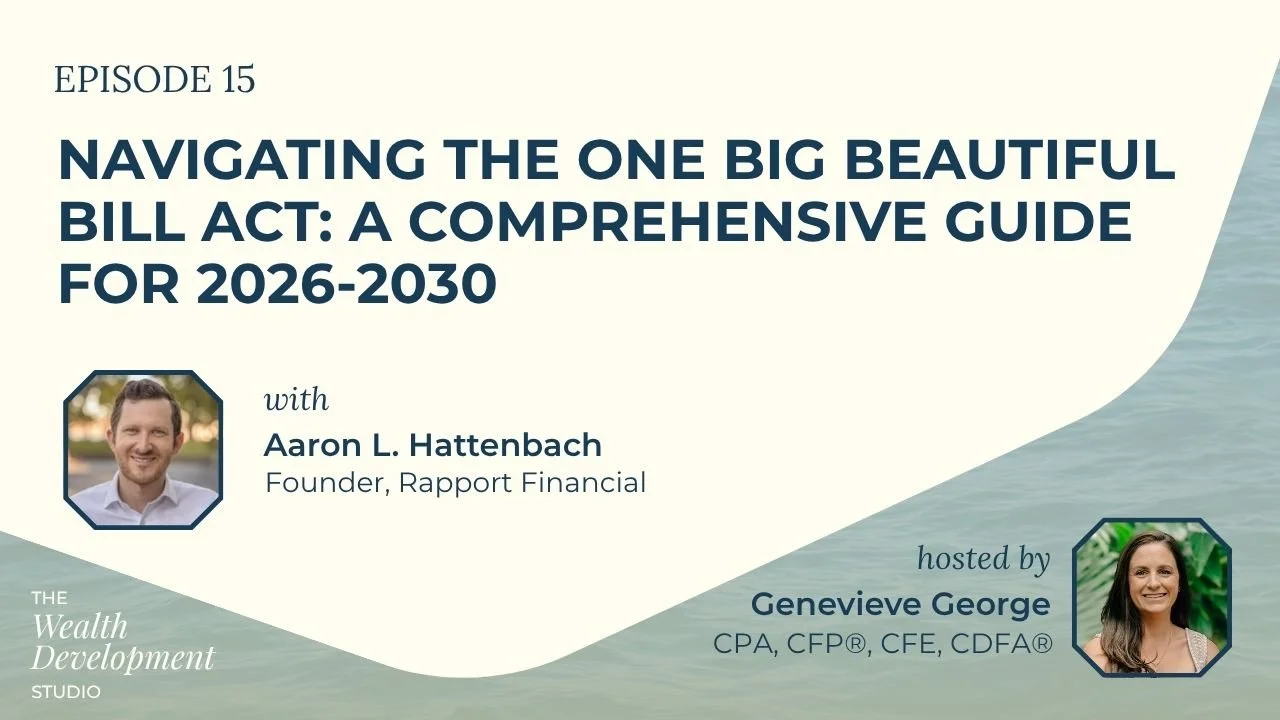
In this episode, Aaron Hattenbach, founder of Rapport Financial, breaks down the key elements of the new legislation and how they show up in real financial decisions. He explains the most consequential provisions of the OBBBA and how each piece connects, so you can bring more questions to your financial planner and CPA before the next planning window closes.
Listen in to learn how to evaluate planning opportunities within this new structure, align tax strategies with your long-term goals, and make informed decisions that support both your current financial life and the legacy you want to build.
Navigating the One Beautiful Bill Act: A Comprehensive Guide for 2026-2030
Disclosure:
- Pelican Financial Planning and Wealth is a registered investment adviser that only conducts business in jurisdictions where it is properly registered, or is excluded or exempted from registration requirements. Registration is not an endorsement of the firm by securities regulators and does not mean the adviser has achieved a specific level of skill or ability. The firm is not engaged in the practice of law or accounting.
- Pelican Financial Planning and Wealth reserves the right to edit blog entries and delete comments that contain offensive or inappropriate language. Comments that potentially violate securities laws and regulations will also be deleted.
- The information presented is believed to be factual and up-to-date, but we do not guarantee its accuracy and it should not be regarded as a complete analysis of any topics discussed. All expressions of opinion reflect the judgment of the authors on the date of the post and are subject to change. A professional adviser should be consulted before making any investment decisions. Content should not be viewed as personalized investment advice, as an offer to buy or sell any of the securities discussed, or as legal or tax advice. Always consult an attorney or tax professional regarding your specific legal or tax situation.
- All investments and strategies have the potential for profit or loss. Different types of investments involve higher and lower levels of risk. There is no guarantee that a specific investment or strategy will be suitable or profitable for an investor’s portfolio. There are no assurances that an investor’s portfolio will match or exceed a specific benchmark.
- Historical performance returns for investment indexes and/or categories usually do not deduct transaction and/or custodial charges, or advisory fees, which would decrease historical performance results.
- Hyperlinks on this blog are provided as a convenience. We cannot be held responsible for information, services, or products found on websites linked to our posts.
